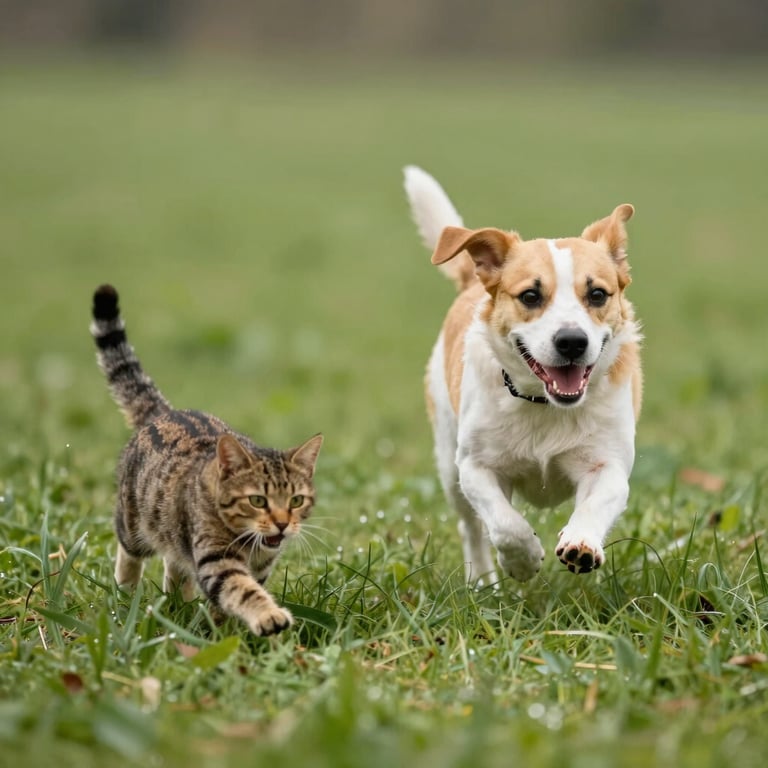
Why Do Some Dogs Chase Cats: Understanding Behavior
Why Do Some Dogs Chase Cats? Dogs chase cats due to an innate prey drive, influenced by breed instincts, early socialization, and the cat's reaction. Learn how to manage this behavior through positive reinforcement training and understand the factors that lead to aggression or playful chasing.
Buddy 🦮
6/28/20268 min read
The Innate Prey Drive Explained
The behavior of dogs chasing cats can be attributed to an instinctual trait known as the prey drive, which is deeply rooted in their evolutionary background. This drive is an inherited characteristic that has been passed down from their wild ancestors, who relied on hunting to survive. For dogs, this instinct compels them to pursue items that exhibit quick movements, such as a darting cat or a swift rodent, reflecting behaviors necessary for securing food.
When a dog observes a fast-moving object, such as a cat running away, a series of neurological responses are triggered. The sight of the fleeing animal activates specific brain areas responsible for hunting instincts, releasing adrenaline and other neurotransmitters that motivate the dog to chase. This reaction is a remnant of predatory instincts that once helped wild canines to hunt for food. Consequently, this behavior is not solely a reflection of aggression; rather, it is a product of intrinsic biology hard-wired into their genetic makeup.
Moreover, the prey drive is influenced by the breed and individual temperament of the dog. Certain breeds, such as terriers and sight hounds, exhibit a particularly strong instinct to chase due to their breeding backgrounds. This inherited trait can manifest in various ways, from a playful pursuit to a more serious chase, depending on the dog's disposition and training history. It is essential to recognize that not all dogs will have the same level of prey drive; some may display minimal interest in chasing, while others may become highly focused on their target.
Understanding this instinctual behavior helps pet owners manage their dogs during encounters with cats and other small animals, allowing for more harmonious relationships. By utilizing training techniques that accommodate the dog’s prey drive, owners can minimize unwanted chasing behaviors, ensuring that both pets coexist safely and peacefully.
Prey Drive vs. True Aggression: What’s the Difference?
Understanding the behavior of dogs in relation to their interactions with cats involves delving into two primary concepts: prey drive and true aggression. Prey drive refers to the inherent, instinctual behavior observed in many dog breeds, where a strong urge propels them to chase after moving objects, including smaller animals like cats. This instinct is deeply rooted in their evolutionary history, where hunting for food was essential for survival. As a result, many dogs are instinctively motivated to chase something that appears to be fleeing, triggering their natural chasing behavior.
On the other hand, true aggression is defined by a more serious behavioral issue, where a dog exhibits hostile intentions towards another animal or person. This may include growling, snapping, or even biting. It is crucial to differentiate between the thrill of the chase fueled by play and genuine aggression that can result in harm. For dogs, what appears to be a chase might stem from a playful instinct, where they simply wish to engage with the cat rather than inflict harm. In many cases, these behaviors are motivated by excitement and curiosity rather than malice.
However, it is essential to recognize that, under certain circumstances, the excitement associated with the chase can escalate into aggressive behavior. For example, if a dog feels threatened or if the chase intensifies excessively, biting or grabbing may occur. This escalation from a lighthearted chase to aggression usually requires careful monitoring and intervention. By understanding the vital distinctions between prey drive and true aggression, dog owners can manage behaviors more effectively, ensuring both their pets and other animals, such as cats, can coexist safely without confusion stemming from instinctual actions.
Genetic Influences: How Breed Traits Matter
Dogs, belonging to a diverse range of breeds, exhibit a variety of behaviors that can be traced back to their genetic lineage. One notable behavior exhibited by certain breeds is the tendency to chase other animals, including cats. This behavior often stems from their instinctual prey drive, which varies significantly across different dog breeds due to historical roles and selective breeding practices.
High prey drive breeds, such as terriers and retrievers, were specifically bred for hunting and retrieving games. Terriers, originally bred to hunt vermin, possess a strong impulse to chase and capture smaller animals. Retrievers, on the other hand, were designed to retrieve game, often leading to an instinctual urge to pursue and engage with fast-moving creatures. As a result, these breeds may display a heightened interest in cats, often viewing them as potential prey or playmates, depending on their upbringing and socialization.
Conversely, some breeds demonstrate a lower prey drive, including bulldogs and Great Pyrenees. Bulldogs have been bred primarily for companionship and have a tendency toward a more relaxed disposition, which may diminish their inclination to chase other animals. Great Pyrenees, traditionally utilized as livestock guardians, tend to have a calm demeanor and a protective instinct that may redirect their attention away from pursuing small animals like cats.
The variations in prey drive not only affect how dogs interact with cats but also illustrate the influence of genetic predisposition on behavior. Understanding these genetic influences can provide valuable insight into why certain breeds are more prone to chasing cats. Through proper training and socialization, the instinctual behaviors of high prey drive dogs can often be managed, allowing for peaceful coexistence with cats and other small animals.
The Importance of Early Socialization
The early socialization of puppies is an essential component in shaping their behavior and interactions with other animals, particularly cats. During the critical window of social development, which typically occurs between three and fourteen weeks of age, puppies are highly receptive to new experiences. This is the time when they can form positive associations with different stimuli, including various species they might encounter, such as cats.
Exposure to cats during this phase can help a dog learn to view them not as prey but as potential companions. When puppies interact with cats in a controlled, positive environment, they can develop a more tempered attitude toward them. These early interactions significantly influence how a dog perceives cats later in life, fostering a sense of familiarity and reducing aggressive instincts.
Conversely, puppies that lack exposure to cats during these formative weeks may grow up with heightened instincts to chase or even attack what they perceive as prey. This lack of socialization can cultivate fear or aggressive behaviors towards cats, which may lead to problematic interactions. It is not uncommon for adult dogs who have not been previously socialized with cats to exhibit chasing behaviors, rooted in the animal’s instinctual drive to hunt. Hence, early socialization can mitigate such tendencies.
Consequently, when owners progressively introduce their puppies to feline companions, they are not merely engaging in a simple activity; they are actively shaping the dog’s overall perceptions and attitudes. This proactive approach enhances harmony in multi-pet households and fosters a deeper bond between dogs and their feline counterparts. By prioritizing early socialization, pet owners can significantly influence their dogs' behaviors towards cats, leading to more peaceful cohabitation and reducing the likelihood of distressing encounters.
The Role of the Cat’s Behavior in the Chase
The dynamic between dogs and cats is often perceived through the lens of predation, particularly when it comes to dogs chasing cats. However, it is essential to recognize that the behavior of the cat plays a significant role in influencing the actions of the dog during such encounters. A confident cat may deter a chasing dog, while a fearful or panicking cat can inadvertently trigger the dog’s instinctual behaviors, leading to a heightened chase response.
When a cat exhibits a calm and confident demeanor, it may not provoke the same instinctual drive in a dog. A cat that stands its ground, engages in assertive body language, or even approaches the dog can signal to the dog that there is no threat, leading to a peaceful interaction rather than a chase. This confident posture can effectively dissuade the dog from pursuing it, as the dog often interprets the cat’s behavior as non-threatening.
Conversely, when a cat displays signs of fear such as running away, hissing, or puffing up to appear larger, it may trigger the dog’s predatory instincts. In this scenario, the dog may interpret the cat’s flight response as an invitation to chase, compounding the instinctual behavior that has historically evolved in dogs. This reaction is deeply rooted in both animals' evolutionary backgrounds, where prey animals often flee when threatened, and predators give chase.
Moreover, the individual personalities of both cats and dogs can further complicate this interaction. Some dogs may be more predisposed to chase based on their breed characteristics or past experiences, while some cats may react more boldly or submissively in the presence of a dog. Understanding these nuanced interactions is crucial for pet owners to manage and foster better relationships between their companion animals.
Managing Prey Drive Through Training
Managing a dog’s prey drive is crucial for promoting peace and safety in households where cats reside. Prey drive is an instinctive behavior that many dogs possess, which can lead them to chase smaller animals. Through structured training, dog owners can effectively mitigate this instinct and encourage calm behavior around cats.
One of the most effective methods for managing prey drive is positive reinforcement training. This approach involves rewarding desired behaviors, rather than punishing unwanted ones. For example, when a dog remains calm and focused on their owner instead of chasing a cat, they can be rewarded with treats, praise, or playtime. This strengthens the association between calm behavior and positive outcomes.
Additionally, desensitization can be utilized as a training technique. This process involves gradually exposing a dog to a cat in a controlled environment, starting from a distance where the dog feels less inclined to chase. Each time the dog successfully focuses on their owner or remains calm despite the presence of a cat, rewards should be provided. Over time, this helps reduce the dog's arousal levels around cats.
Consistency is key when managing a dog’s prey drive. Training sessions should be regular and brief to keep the dog engaged and avoid frustration. Owners should also ensure that their dogs are exercised enough to reduce overall energy levels, as a well-exercised dog is generally less likely to exhibit heightened prey drive characteristics.
Incorporating training activities that promote impulse control can also be beneficial. Exercises such as 'leave it' or 'stay' can teach dogs to resist the urge to chase. It is imperative that owners remain patient and are prepared for gradual progress, as behavioral changes often require time and repetition.
Conclusion: Balancing Instincts with Training
Understanding the instinctual behavior of dogs, particularly their tendency to chase cats, is crucial for creating a harmonious living environment. This behavior is rooted in their natural predatory instincts, which were developed through evolution and selective breeding. Dogs perceive small animals, such as cats, as potential prey. Thus, the instinct to chase is often hardwired in their behavior. However, it is essential for pet owners to recognize that while these instincts exist, proper training can significantly mitigate undesirable actions.
With knowledge and effective training techniques, it is entirely possible to teach dogs to coexist peacefully with cats. Pet owners can employ various strategies, such as positive reinforcement and controlled introductions, to foster a sense of calm and understanding between the two species. Training sessions should focus on redirecting the dog's attention when they exhibit chasing behavior and rewarding them for remaining calm in the presence of a cat. Additionally, gradual exposure and socialization can aid in acclimating both pets to each other’s presence without inciting a chase response.
Practicing responsible pet ownership involves understanding not only a dog’s instincts but also their learned behaviors. By establishing a safe and structured environment, dog owners can help their pets learn to respect boundaries. Moreover, advocating for the well-being of both dogs and cats will lead to a more balanced household. In summary, while it is natural for dogs to chase cats, a thoughtful approach combining knowledge and training can promote a peaceful coexistence, allowing both pets to thrive together.